Imagine hurtling through space at 28,000 kilometers per hour when Mission Control suddenly clears their throat: "Disengage autopilot. Take the stick."
The Artemis II crew did exactly that, performing a "manual piloting demonstration" to prove that even with millions of lines of code, the human hand is the ultimate safety net for high-stakes maneuvers.
Most of us live on a different kind of autopilot… the Anxiety Autopilot.
It’s that tight, hollow sensation in your chest and the "doom-loop" of thoughts that starts the moment you wake up. You feel like a passenger in your own mind, watching helplessly as your stress levels climb toward "Max Q."
In this blog, we’re adapting the Artemis II "Manual Override" protocol into a 4-step mental health practice.
By the end, you’ll move from being a frantic passenger to a confident pilot, capable of navigating your week’s "G-force" with precision and calm.
Ready to launch? Let’s go!
Why Unmanaged Anxiety Controls Your Life
The cost of letting your "Anxiety Autopilot" run the show is higher than you might think.
According to the World Health Organization (WHO), anxiety and depression cost the global economy approximately $1 trillion per year in lost productivity.
And it’s not because people are absent, but because they are "present" while mentally unwell.
Anxiety is essentially a biological attempt to predict the future to keep you safe.
When your brain perceives a threat—whether it’s a high-stakes project or a difficult conversation—it floods your body with cortisol and adrenaline.
This "fight, flee, or freeze" mode is helpful for immediate survival, but in the modern world, it often becomes a chronic state of exhaustion.
When you don't intentionally manage this response, three things happen:
- Tunnel Vision: Your brain stops looking for creative solutions and starts overthinking potential disasters.
- Decision Fatigue: Every choice feels life-or-death, leading to mental paralysis.
- Emotional Burnout: You spend so much energy managing the internal alarm that you have nothing left for your family, your health, or your work.
This matters because your brain cannot distinguish between a minor stressor and a true crisis on its own.
If you don't learn how to "take the controls" manually, your body will continue to treat every email like a structural failure.
The 4-Step Manual Override Practice
This practice is designed to pull your brain out of survival mode and return it to a state of logical control.
By following these steps, you shift from automated distress to manual precision.
1. Label the Physical Sensation
The moment you feel a spike of adrenaline (shallow breathing, a racing heart, or a tight chest) stop and name it.
Say to yourself, "I am experiencing a high-pressure alert." Labeling the physical sensation moves brain activity from the emotional center (the amygdala) to the logical center (the prefrontal cortex).
You are no longer "the anxiety"; you are the observer of the data.
2. Identify the Threat Level
Ask yourself: "Is this an immediate physical threat or a future-based worry?"
Most anxiety is an "autopilot" response to things that haven't happened yet. If there is no immediate danger, acknowledge that your survival system is overreacting.
This is the moment you disengage from the emotional loop and prepare to take control.
3. Regulate Your Breathing
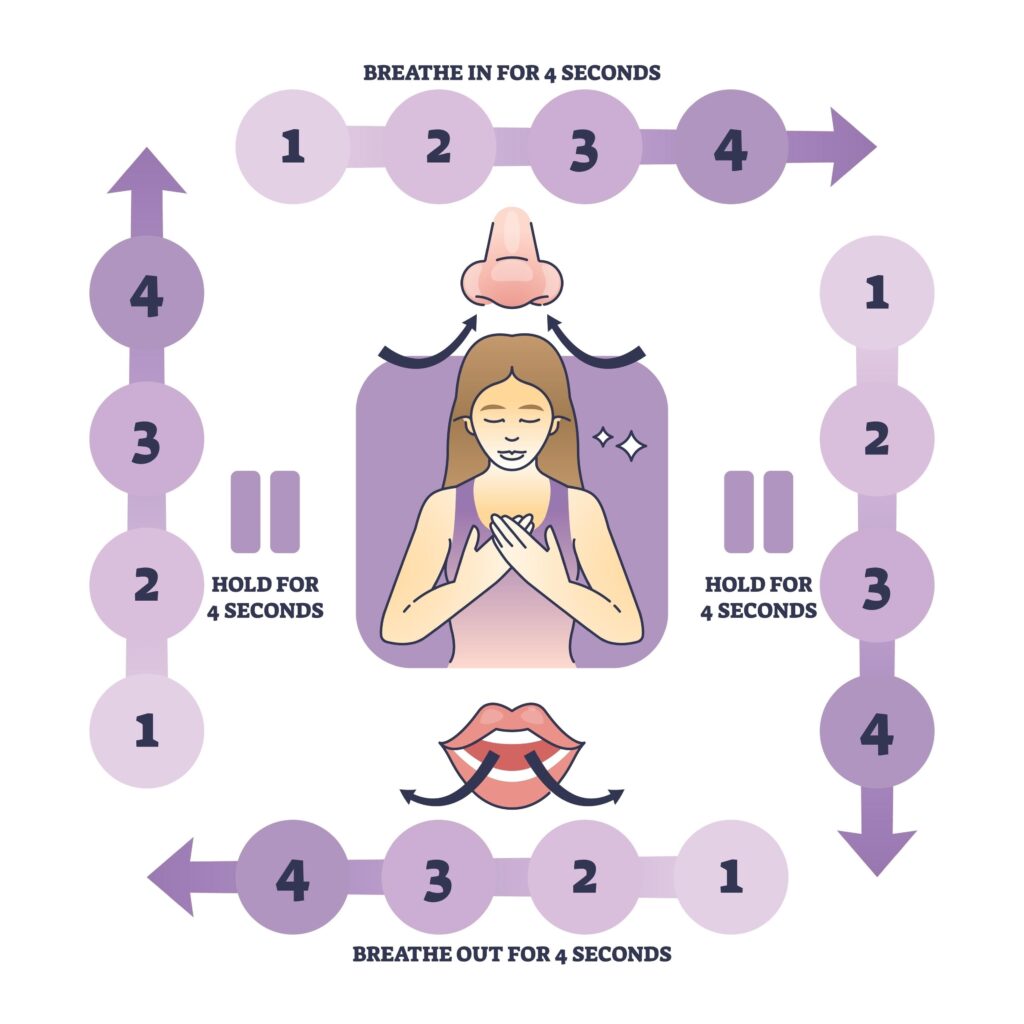
Perform a grounding maneuver to stabilize your nervous system using Box Breathing:
- Inhale for 4 seconds.
- Hold for 4 seconds.
- Exhale for 4 seconds.
- Hold for 4 seconds. This is a physiological manual override. It forces your body to exit the "fight or flight" response and enter a "rest and digest" state.
If box breathing isn’t for you, give breathing techniques or mindfulness practices a quick Google search.
4. Take One Small Action
Identify the single smallest task you can complete in the next five minutes that is within your Sphere of Control.
If you are overwhelmed by a project, the action isn't "finishing the work" it is "opening a blank document" or "sending one email."
Taking one intentional step proves to your brain that you are back in command.
Why This Works
Research shows that these types of interventions are highly effective.
A study published by the American Psychological Association (APA) found that mindfulness-based stress reduction is as effective as common medications for reducing anxiety because it physically rewires the brain’s response to stress.
You are training your brain to trust your manual input over its automated fear.
Summary: Taking Control of Your Mental Flight Path
The Artemis II mission reminds us that even the most sophisticated systems require a human touch during high-stakes moments.
Your anxiety is an automated survival system that occasionally needs a manual override to stay on course.
Key Takeaways:
- Anxiety is Autopilot: It is a biological attempt to predict the future, but it often treats minor stressors like life-threatening emergencies.
- The Cost of Inaction: Unmanaged stress leads to tunnel vision, decision fatigue, and significant losses in personal and professional productivity.
- The Manual Override: You can interrupt the "doom-loop" by labeling your sensations, identifying the true threat level, regulating your breath, and taking one small, controlled action.
By practicing these four steps, you move from being a passenger to the pilot of your own mental wellness. You have the training and the tools to navigate the "G-force" of your life with precision.
Which of these four steps do you find the most challenging to implement when things get stressful?
To get more reflections, tools, and lived-experience experiments, you can subscribe to the email list at thejeffturner.ca.
If you’re looking to take a bigger step in managing overthinking, check out the FREE Front-Line Worker’s Guide to Managing Overthinking.
Until next time. I’m Jeff, and remember to take care of yourself, however that looks to you.